Category: Blog

Your blog category

  • Crown vs Cap: What Is the Difference? A Baner Dentist Explains

    Crown vs Cap: What Is the Difference? A Baner Dentist Explains

    Key Takeaways

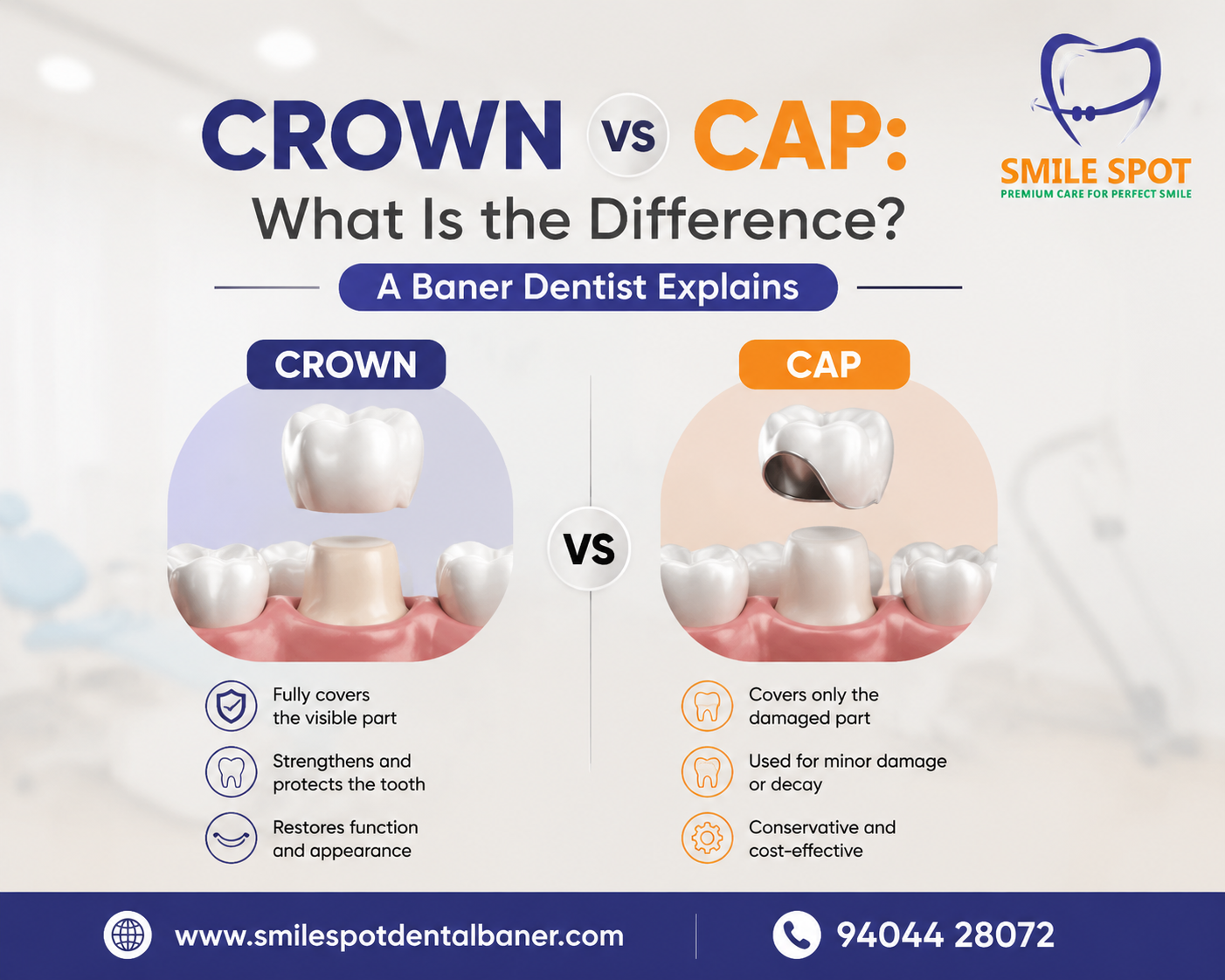
    • A dental crown and a dental cap are the same thing. ‘Cap’ is the informal patient term; ‘crown’ is the clinical term used by dentists.
    • Crowns are needed after root canal treatment, for severely damaged or cracked teeth, for dental implants and for cosmetic smile redesign.
    • Four main crown materials are available in Baner: metal, PFM (porcelain-fused-to-metal), all-ceramic and zirconia.
    • Zirconia crowns are the strongest and most aesthetic option, with a lifespan of 10 to 15 years.
    • Dental crown cost in Baner ranges from INR 1,500 (metal) to INR 15,000 (zirconia) depending on material and tooth position.
    • A crown procedure at Smile Spot, Baner takes 2 appointments: one for preparation and one for final placement.
    • Over 80% of molar teeth that undergo root canal treatment require a crown to protect the weakened tooth structure (Industry estimate).

    Introduction

    Your dentist says you need a ‘crown’. Your family refers to it as a ‘cap’. Are they the same thing? Yes, they are. Dental crown vs cap difference Baner dentist is one of the most common confused patient queries we see, and the confusion is completely understandable.

    This post explains the crown vs cap question plainly, covers the four main materials available at Smile Spot Baner, explains the procedure steps and gives you transparent cost ranges. The goal is for you to walk into your appointment informed and confident about the treatment you are receiving.

    Quick Facts: Dental Crowns in Baner, Pune

    LabelFact
    Is a crown the same as a cap?Yes. ‘Cap’ is informal; ‘crown’ is the clinical term
    Metal crown cost in BanerINR 1,500 to 3,000
    PFM (porcelain-fused-to-metal) crown costINR 3,000 to 6,000
    All-ceramic crown cost in BanerINR 4,000 to 8,000
    Zirconia crown cost in BanerINR 8,000 to 15,000
    Typical crown lifespan7 to 15 years depending on material and hygiene
    Number of appointments for a crown2 appointments (preparation and final fitting)

    Pune Dental Crown Statistics 2025-2026

    MetricData PointSource
    Molar RCT cases requiring crown protectionOver 80%Industry estimate
    Dental caries prevalence in Indian adults requiring restorationApproximately 67%ICMR, 2023
    Average crown lifespan with good oral hygiene10 to 15 yearsPubMed / Prosthodontic literature
    Share of Pune patients choosing zirconia crowns in 2025Approximately 40 to 50%Industry estimate
    Average crown failure rate over 10 years5 to 15% depending on materialPubMed
    Cost of crown re-cementation after debonding in PuneINR 500 to 1,500Industry estimate
    Patients preferring tooth-coloured crowns in urban IndiaOver 65%Industry estimate

    Crown vs Cap difference Baner dentist Explained

    A dental crown is a tooth-shaped restoration that fits over a prepared natural tooth, covering it entirely from the gum line upward. It restores the tooth’s shape, size, strength and appearance. In everyday Indian conversation, patients call this a ‘cap’ because it sits over the tooth like a cap sits on a head.

    Dentists use ‘crown’ because that is the correct clinical and prosthodontic term. When Dr. Bhole refers to your dental crown, and your family asks about your cap, they are talking about the same piece of restorative work.

    When Is a Dental Crown Needed?

    • After root canal treatment to protect the weakened, non-vital tooth structure, particularly for molars and premolars.
    • When a tooth is severely cracked, fractured or worn down and cannot be restored with a filling alone.
    • To cover a dental implant (implant crown) after the implant has integrated with the jawbone.
    • For cosmetic improvement as part of a smile designing treatment when veneers are not suitable.
    • To anchor a dental bridge when replacing a missing tooth without implants.
    • To protect a tooth that has large, failing fillings with insufficient tooth structure remaining.

    The Four Types of Dental Crowns Available at Smile Spot, Baner

    1. Metal Crowns

    Metal crowns are made of gold alloy, silver alloy or base metal alloys. They are the most durable option and can withstand significant biting force. They require less tooth reduction than other materials. The drawback is aesthetics: they are clearly visible when you smile, making them suitable only for back molars that do not show during normal speaking or smiling.

    2. Porcelain-Fused-to-Metal (PFM) Crowns

    PFM crowns have a metal substructure for strength with a porcelain outer layer for aesthetics. They look natural and are suitable for both front and back teeth. Over time, the metal margin at the gum line can become visible as gums recede slightly, which is a cosmetic concern for some patients. PFM remains one of the most commonly placed crown types in Pune due to its cost-effectiveness.

    3. All-Ceramic Crowns

    All-ceramic crowns contain no metal. They offer excellent aesthetics and are the best choice for front teeth where appearance is a priority. They are slightly less strong than zirconia crowns but adequate for front teeth that are not under heavy biting load. They are biocompatible and suitable for patients with metal allergies.

    4. Zirconia Crowns

    Zirconia (zirconium dioxide) crowns are the strongest and most aesthetic option currently available. They are metal-free, extremely durable and look virtually identical to natural teeth. Zirconia crowns are the preferred choice for patients who want the best combination of strength and aesthetics, particularly for teeth visible when smiling. They are also available as monolithic zirconia (solid, for extra strength) or layered zirconia (coated with ceramic for enhanced aesthetics).

    Crown Materials Comparison Table

    Crown TypeStrengthAestheticsBest ForCost in Baner (INR)Lifespan
    MetalHighestPoor (silver/gold colour)Back molars, grinders1,500 to 3,00015+ years
    PFMHighGoodFront and back teeth3,000 to 6,00010 to 15 years
    All-ceramicModerateExcellentFront teeth4,000 to 8,0008 to 12 years
    ZirconiaVery highExcellentFront and back teeth8,000 to 15,00010 to 15+ years

    Procedure Steps: Getting a Crown at Smile Spot, Baner

    StepWhat HappensChair Time
    Appointment 1: ExaminationX-ray assessment, tooth condition evaluation, material discussion15 to 20 minutes
    Appointment 1: Tooth preparationTooth shaped under local anaesthesia to receive crown; 1 to 2 mm removed from outer surface30 to 40 minutes
    Appointment 1: ImpressionDigital scan or putty impression of prepared tooth sent to dental lab10 minutes
    Appointment 1: Temporary crownTemporary acrylic crown placed to protect tooth during lab fabrication10 minutes
    Lab fabricationCrown made at dental lab (typically 5 to 7 working days)N/A
    Appointment 2: Final fittingTemporary crown removed, permanent crown tried in, adjusted, cemented30 to 40 minutes

    Post-Treatment Oral Hygiene After a Crown

    A crown protects a prepared tooth but it does not make it invincible. Decay can still develop at the margin where the crown meets the gum line if oral hygiene is poor. Follow these steps:

    • Brush twice daily including the gum line around the crown, where plaque accumulates.
    • Floss daily. Use a floss threader or interdental brush to clean under the crown margin.
    • Avoid biting very hard foods such as ice, hard candy or bones. This applies especially in the first 48 hours after crown cementation.
    • Wear a night guard if your dentist has noted tooth grinding (bruxism). Grinding accelerates crown wear significantly.
    • Attend annual dental checkups so the crown margin and underlying tooth can be reviewed for early signs of decay.

    Cosmetic vs Clinical Indications for a Dental Crown

    IndicationClinical NeedCosmetic Need
    After root canal treatmentEssential for molar protectionSecondary benefit: improved appearance
    Cracked toothPrevents fracture progression and painRestores natural tooth shape
    Severely worn teethRestores bite function and heightRestores smile aesthetics
    Implant restorationRequired to function as a toothMatches adjacent tooth colour
    Large failing fillingPrevents tooth fracture under chewing loadRemoves discolouration from old amalgam
    Cosmetic enhancementMay not be clinically necessaryCore purpose: smile redesign

    Dental Crown Care in Baner: Serving Aundh, Wakad and Pashan

    Smile Spot Orthodontics and Multispeciality Dental Clinic in Baner, Pune offers all four major crown materials with in-clinic digital impressions for faster turnaround and a better fit. Dr. Akshay Bhole discusses your clinical needs, cosmetic preferences and budget during the first appointment before any preparation begins. There are no surprise costs at Smile Spot: you receive a complete treatment estimate at consultation.

    Patients from Aundh, Wakad, Pashan and Sus commonly visit Smile Spot for crown placement after root canal treatment. An IT professional from Hinjewadi recently completed a zirconia crown on her upper right molar after RCT. She chose zirconia specifically because she was concerned about the metal showing during client presentations. The final crown was indistinguishable from her natural teeth.

    Frequently Asked Questions

    Q: Is a dental crown and a cap the same thing?

    A: Yes, they are exactly the same. ‘Cap’ is the common patient term used across India, while ‘crown’ is the clinical and technical term used by dentists. Both refer to a tooth-shaped restoration that covers an entire prepared tooth from the gum line upward to restore its shape, strength and appearance.

    Q: Which crown material is best for a molar tooth in Baner?

    A: For molars, zirconia crowns offer the best combination of strength and aesthetics. If budget is a constraint, PFM crowns are a reliable and widely used alternative. Metal crowns are the most durable and least expensive but are only appropriate for teeth not visible when smiling. Your dentist will recommend the best material based on your bite force, aesthetic preference and budget.

    Q: How long does a dental crown last in Pune?

    A: Crown lifespan ranges from 7 to 15+ years depending on the material, your oral hygiene and whether you have a grinding habit. Zirconia and metal crowns tend to last longest. Regular dental checkups allow early detection of any issues at the crown margin, such as secondary decay, that can extend the crown’s functional life when caught early.

    Q: Does a crown hurt? What is the procedure like?

    A: Crown preparation is performed under local anaesthesia and is generally comfortable. You may feel mild pressure during tooth shaping. Soreness for 24 to 48 hours after the preparation appointment is normal. Final crown cementation is quick and painless. Most patients find the process far less uncomfortable than they expected.

    Q: Do I need a crown after every root canal treatment?

    A: Not always, but for most molar and premolar teeth, yes. Root canal treatment removes the tooth’s blood supply, making it more brittle over time. A crown distributes chewing forces evenly and prevents the tooth from fracturing. Front teeth (incisors and canines) after RCT may or may not need a crown, depending on how much natural tooth structure remains.

    Q: What is the cost of a dental crown at Smile Spot, Baner?

    A: Crown costs at Smile Spot Baner depend on material: INR 1,500 to 3,000 for metal, INR 3,000 to 6,000 for PFM, INR 4,000 to 8,000 for all-ceramic and INR 8,000 to 15,000 for zirconia. These ranges are approximate and vary based on tooth position and case complexity. A firm estimate is provided at consultation before any treatment begins.

    Conclusion

    The dental crown vs cap difference question has a simple answer: they are the same restoration with two different names. What matters more than terminology is choosing the right material for your clinical situation, aesthetic needs and budget. Zirconia offers the best of all worlds if cost allows. PFM remains an excellent, proven choice for most patients.

    At Smile Spot Orthodontics and Multispeciality Dental Clinic in Baner, Dr. Akshay Bhole (BDS, MDS – Orthodontics and Invisalign Provider) and the team provide transparent crown consultations with clear material comparisons and cost estimates before any preparation begins.

    Ready to protect your tooth with the right crown? book a consultation at our clinic in Baner, Pune.
  • Cost of Braces in India 2026: A Complete Guide

    Cost of Braces in India 2026

    Cost of Braces in India 2026 ranges from approximately Rs 15,000 for basic metal braces to Rs 2,50,000 or more for clear aligner systems. The final price depends on the type of braces, the severity of misalignment, your city, and your orthodontist’s experience. This guide gives you accurate current ranges for every type so you can compare before booking a consultation.

    Braces treatment is one of the most common orthodontic procedures in India, and also one of the most searched when it comes to pricing. Most people find it difficult to get a straight answer because the cost genuinely varies – sometimes by Rs 80,000 or more -depending on which type of braces you choose and where you get treated.

    This guide covers the four main types of braces available in India in 2026, what each type costs, what drives the variation in price, and what questions you should ask your orthodontist before agreeing to treatment.

    Cost of Braces in india 2026: At a Glance

    Type of BracesApprox. Cost (Full Treatment)VisibilityBest Suited For
    Metal BracesRs 15,000 – Rs 45,000High (silver)Children, teens, complex corrections
    Ceramic BracesRs 25,000 – Rs 70,000Medium (tooth-coloured)Adults who want less visible brackets
    Clear Aligners (Invisible)Rs 70,000 – Rs 2,50,000Very low (clear trays)Mild to moderate alignment in adults
    Lingual BracesRs 1,20,000 – Rs 2,50,000+None (behind teeth)Adults with professional or social constraints

    Metal Braces: The Most Affordable Option

    Metal braces remain the most widely used orthodontic treatment in India and are the most affordable entry point for correction. They use stainless steel brackets bonded to each tooth, connected by a metal wire that your orthodontist tightens at regular intervals to guide teeth into alignment.

    Typical cost range: Rs 15,000 to Rs 45,000 for a full course of treatment covering both arches.

    What affects the price within this range:

    • Quality and brand of the bracket system used
    • Whether treatment involves one arch or both
    • The number of months required, which depends on the severity of misalignment
    • Cities – metros like Mumbai, Delhi, and Bengaluru tend to cost more than Tier 2 cities
    • Specialist orthodontist versus a general dentist offering orthodontic services

    Metal braces are the best-studied, most clinically proven option for complex corrections, including crowding, spacing, and bite problems. The main trade-off is visibility – the brackets are clearly visible when you speak or smile.

    Ceramic Braces: Less Visible at a Moderate Premium

    Ceramic braces work exactly like metal braces in terms of mechanism, but use tooth-coloured or clear ceramic brackets instead of metal ones. This makes them significantly less noticeable in everyday conversation, which is why they are popular among working adults.

    Typical cost range: Rs 25,000 to Rs 70,000 depending on brand, duration and location.

    A few things to know before choosing ceramic braces:

    • The ceramic material can stain over time if you drink coffee, tea, or have a high-turmeric diet. Your orthodontist should advise on this before you commit.
    • Ceramic brackets are slightly more fragile than metal, which occasionally means a bracket needs to be replaced mid-treatment.
    • The wire is often still metal coloured, which means the overall look is less discreet than clear aligners but more so than full metal braces.

      We provide a range of orthodontic treatment options, including ceramic braces, to help patients achieve healthier, well-aligned smiles with personalized care.

    Clear Aligners (Invisible Braces): The High-Comfort Option

    Clear aligners – sometimes called invisible braces – are custom-made plastic trays that fit over your teeth. Instead of wires and brackets, you wear a series of trays that gradually shift your teeth. You remove them while eating and brushing, which is the biggest practical advantage over fixed braces.

    Typical cost range: Rs 70,000 to Rs 2,50,000 depending on the brand, the number of aligners required, and your orthodontist’s fee.

    Why is the price range wide:

    • International brands like Invisalign carry a significant brand premium and typically cost Rs 1,50,000 to Rs 2,50,000 for a comprehensive case.
    • Indian brands and local lab-produced aligners can bring the cost down to Rs 70,000 to Rs 1,20,000 for moderate cases.
    • The complexity of your case matters significantly – a patient needing 10 trays pays much less than a patient needing 40.
    • Refinement trays (additional sets needed if teeth do not track perfectly) are sometimes included in the original quote and sometimes billed separately. Confirm this before signing.

    Clear aligners are not ideal for every case. Severe crowding, certain bite problems, and cases requiring tooth rotation beyond a certain angle are generally better handled with fixed braces. Your orthodontist will tell you whether aligners are clinically suitable for your specific correction.

    Lingual Braces: Completely Hidden, Highest Cost

    Lingual braces are fixed braces placed on the inner (tongue-facing) surface of the teeth rather than the outer surface. Because they are entirely behind the teeth, they are invisible to others during normal interaction. They are the most discreet fixed brace option available.

    Typical cost range: Rs 1,20,000 to Rs 2,50,000 and above for custom-fabricated systems.

    Key considerations:

    • Lingual braces require custom-fabricated brackets – they cannot be adapted from standard bracket systems -which accounts for the higher base cost.
    • The adjustment period for speech is longer than with conventional braces because of the proximity to the tongue.
    • Not all orthodontists are trained in lingual brace placement. Verify your orthodontist’s specific experience before choosing this option.
    • Cleaning requires more care since the brackets are on the inner surface and the standard brushing technique needs to be adapted.

    What Actually Affects the Cost of Braces in India

    Beyond the type of braces, six factors account for most of the price variation you will encounter:

    1. Severity of Misalignment

    Minor crowding or spacing correction with a small number of aligners or a short fixed-brace duration costs far less than a complex case involving multiple teeth, bite correction, or jaw relationship issues. Cases that also require extractions, jaw surgery, or multi-phase treatment will cost more.

    2. Duration of Treatment

    Most braces treatment runs between 12 and 36 months. Longer treatment means more follow-up appointments and, in some cases, additional consumable materials. Some clinics price by duration; others price by case complexity. Know which model your clinic uses before you start.

    3. City and Clinic Location

    Orthodontic fees in Mumbai, Delhi, Pune and Bengaluru are typically 20 to 40 percent higher than in Tier 2 and Tier 3 cities for the same type of braces. This reflects overheads and market positioning rather than clinical quality alone.

    4. Specialist Orthodontist vs General Dentist

    A specialist orthodontist holds an MDS degree in orthodontics following their BDS. They spend two to three additional years training specifically in tooth movement and jaw alignment. General dentists can also provide braces, and many do so competently for straightforward cases. For complex corrections, a specialist is advisable.

    5. Brand of Brackets or Aligner System

    Within each category, bracket and aligner brands vary significantly in price. 3M, Dentsply and Ormco brackets sit at the upper end of the metal and ceramic range. Invisalign leads aligner pricing. Indian-manufactured alternatives are clinically effective and considerably more affordable. Ask your orthodontist which brand they use and why.

    6. What Is Included in the Quote

    Some clinics provide an all-in quote covering all adjustments, X-rays, retainers, and follow-up visits. Others charge separately for X-rays, retainers after treatment, and any replacement brackets. A lower headline cost is not always a lower total cost. Get a written treatment plan with a clear list of what is and is not included.

    Do Not Forget the Cost of Retainers

    Retainers are worn after active braces treatment to hold teeth in their new position. This phase is often not mentioned prominently during the initial consultation, but it is a necessary part of the treatment cycle.

    Retainer cost ranges in India in 2026:

    • Removable (Hawley or Essix) retainers: Rs 2,000 to Rs 8,000 per arch
    • Fixed (bonded) retainers: Rs 3,000 to Rs 10,000 per arch
    • Clear retainer sets: Rs 5,000 to Rs 15,000 per arch

    Most people need retainers for at least the first 12 months after braces come off, with some form of retention recommended indefinitely. Factor this into your total treatment budget.

    5 Questions to Ask Your Orthodontist Before Committing

    • Is the quote I am receiving an all-inclusive figure, or will there be additional charges for X-rays, retainers, or replacement brackets?
    • What is your clinical recommendation for my specific case -which type of braces is most appropriate and why?
    • How long is the estimated treatment duration, and what could extend it?
    • How many adjustment appointments will I need, and are these included in the treatment cost?
    • What happens if a bracket breaks or an aligner tray is lost – is replacement covered?

    Frequently Asked Questions

    How much do braces cost in India in 2026?

    The cost ranges from Rs 15,000 for standard metal braces to over Rs 2,50,000 for lingual or premium clear aligner treatment. The exact figure depends on the type of braces, the complexity of your case, your city, and whether the quote includes retainers and all follow-up visits.

    Are metal braces still a good option in 2026?

    Yes. Metal braces remain clinically effective for all types of misalignment, including complex cases that clear aligners cannot address as reliably. They are also the most affordable option. The only significant drawback is their visibility, which is a personal consideration rather than a clinical one.

    What is the cheapest type of braces available in India?

    Metal braces are the least expensive option, with treatment typically available from Rs 15,000 in Tier 2 and Tier 3 cities and Rs 25,000 to Rs 45,000 in metros. Ceramic braces are the next step up in both cost and aesthetics.

    How much do invisible braces (clear aligners) cost in India?

    Clear aligner systems in India range from approximately Rs 70,000 for Indian-manufactured options in mild cases to Rs 2,50,000 for international brand systems in more complex cases. The brand, the number of aligner sets required, and the clinic’s fee structure all affect the final cost.

    Is the cost of braces covered by dental insurance in India?

    Most standard health insurance policies in India do not cover orthodontic treatment unless it is being done for a medical reason, such as correcting a jaw issue affecting function. Some corporate dental benefits packages include a partial orthodontic allowance. Check your policy document under ‘dental benefits’ or ‘cosmetic exclusions’ for the specific terms.

    How long does braces treatment typically last in India?

    Most treatment runs between 12 and 24 months for routine cases, though complex cases can take up to 36 months or longer. Clear aligner treatment for mild corrections can sometimes be completed in 6 to 12 months.

    Can adults get braces in India?

    Yes. Orthodontic treatment is not age-restricted. Adults choose braces for both functional and aesthetic reasons. The treatment mechanics are the same as for younger patients, though in some adults, bone density means tooth movement is slightly slower. Your orthodontist will advise on realistic timelines during your consultation.

    Do I need to pay for braces in one go or are EMI options available?

    Many orthodontic clinics in India offer instalment-based payment plans, either directly or through healthcare EMI schemes via providers like Bajaj Finserv Health, CreditHealth or similar platforms. Ask the clinic about their payment options during the first consultation. Some require a deposit at the start and collect the remainder in monthly instalments through the treatment period.

    Conclusion

    Before starting treatment, schedule a consultation with a qualified orthodontist to receive a personalized treatment plan and a transparent cost estimate. Comparing treatment options, understanding what is included in the quoted price, and asking the right questions will help you make an informed decision and invest confidently in a healthier, straighter smile.

  • Monsoon Dental Problems:Why Toothaches Spike in Pune’s Rainy Season

    toothache monsoon season Pune dental clinic Baner

    Introduction

    Toothaches do not care about the calendar, but they do get worse when the clouds roll in over Pune. If you have noticed that your teeth hurt more during July and August, you are not imagining it. Monsoon season creates specific biological and environmental conditions that trigger or worsen dental pain, gum infections and tooth sensitivity.

    This post explains exactly why the toothache monsoon season Pune patients experience is more common, what the science says, and what you can do about it. The information is based on verified dental literature and the clinical experience of Dr. Akshay Bhole (BDS, MDS – Orthodontics) at Smile Spot Orthodontics and Multispeciality Dental Clinic in Baner, Pune.

    Quick Facts: Monsoon Dental Problems in Pune

    LabelFact
    Average preventive checkup cost in BanerINR 300 to 800
    Rise in emergency dental visits, monsoon months (July-Sep)15 to 20% (Industry estimate)
    Optimal oral hygiene brushing frequencyTwice daily, 2 minutes each session
    Most common monsoon dental complaintToothache and gum swelling
    Humidity level that accelerates oral bacterial growthAbove 80% relative humidity
    Duration of a basic dental cleaning at Smile Spot, Baner30 to 45 minutes

    Pune Monsoon Dental Health Statistics 2025-2026

    MetricData PointSource
    Adults in India with untreated dental cariesApproximately 67%ICMR 2023
    Indians reporting tooth sensitivity at some point in lifeOver 30%Indian Journal of Dental Research, 2022
    Rise in dental pain complaints during monsoon15 to 20%Industry estimate
    Average cost of emergency toothache treatment in PuneINR 1,500 to 6,000Industry estimate
    Adults in Pune visiting dentist once per year or moreLess than 40%Industry estimate
    Percentage of dental infections linked to pre-existing decayOver 75%NHP India, 2023
    Gum disease prevalence among Indian adults over 35Approximately 60%WHO India Oral Health Report, 2022

    Why Does Monsoon Trigger Toothaches and Gum Problems?

    The monsoon is not a single event. It is a sustained shift in humidity, temperature, immunity and diet that lasts three months. Each of these factors affects your oral health in a different way.

    Humidity and Bacterial Overgrowth

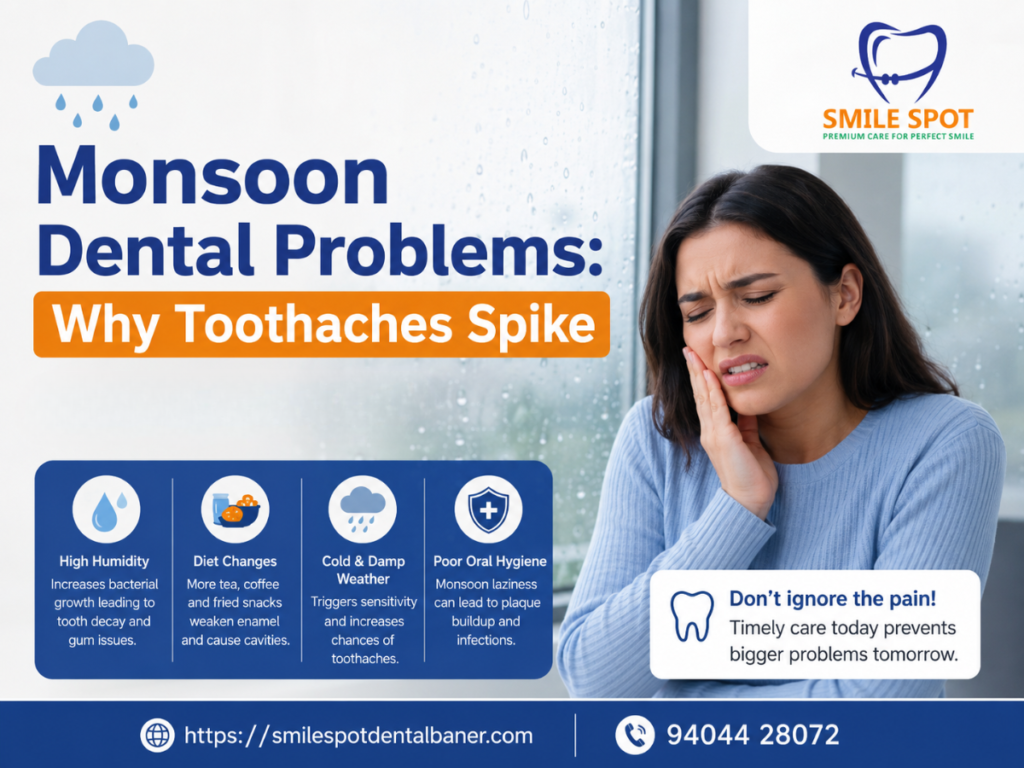
    When relative humidity crosses 80%, the moist environment inside the mouth becomes more hospitable to harmful bacteria. These bacteria produce acids that attack enamel and inflame gum tissue. The result is increased cavity risk, gum swelling and heightened tooth sensitivity.

    Seasonal Immunity Dips

    Season changes are well-documented triggers for minor immune system fluctuations. According to general immunological data cited by NHP India, this temporary dip makes existing dental infections more likely to flare up. A cavity that caused no pain in April can become an abscess by August.

    Dietary Changes During Monsoon

    Bhajias, vada pav, masala corn and chaat from street stalls in Aundh and Wakad are monsoon staples in Pune. These foods are high in refined carbohydrates, which feed cavity-causing bacteria. Cold rain water and chilled beverages also trigger nerve pain in teeth that have existing sensitivity or hairline cracks.

    Most Common Dental Problems During Monsoon in Baner

    1. Toothache and Dental Abscess

    This is the top reason patients visit our dental clinic in Baner during July and August. A toothache in the monsoon is rarely caused by the rain itself. It is caused by bacteria entering a pre-existing cavity or crack, reaching the nerve, and causing it to become inflamed. The immune dip during the season change reduces the body’s ability to keep that infection contained.

    2. Gum Swelling and Bleeding

    Gingivitis (early gum disease) often flares during the monsoon. Patients from Sus and Pashan frequently report that gums that were ‘slightly pink’ in summer become swollen and bleed when brushing once the rains start. High humidity, plaque accumulation and reduced saliva flow during cold months all contribute.

    3. Tooth Sensitivity

    Cold rain, chilled drinks and sour street food are a triple trigger for sensitivity. If your enamel is worn or your gums have receded, the exposed dentine reacts sharply to cold and acidic stimuli. Many IT professionals in Hinjewadi report that their sensitivity worsens considerably during their monsoon commute.

    4. Jaw Pain and Worsening Wisdom Tooth Issues

    Is your jaw clicking or aching more in July? Barometric pressure changes during heavy rain can subtly affect facial sinuses and the temporomandibular joint (TMJ). Partially erupted wisdom teeth also tend to cause increased pain during the monsoon when gum tissue around them swells.

    Procedure Steps Table: Monsoon Dental Checkup at Smile Spot, Baner

    StepWhat HappensChair Time
    1. Clinical examinationVisual and probe check of all teeth, gums and bite10 minutes
    2. X-ray (if required)Digital X-ray to detect hidden decay or abscess5 minutes
    3. Scaling and cleaningRemoval of plaque and tartar build-up20 to 30 minutes
    4. Treatment recommendationPersonalised care plan with cost estimate10 minutes
    5. Preventive treatmentFluoride application or pit and fissure sealant if advised10 minutes

    Cost Comparison: Treating Dental Problems Early vs Late

    ConditionEarly Treatment Cost (INR)Delayed Treatment Cost (INR)
    Cavity (small)INR 800 to 1,500INR 6,000 to 15,000 (Root Canal Treatment needed)
    Gum disease (mild)INR 600 to 1,200 (scaling)INR 8,000 to 25,000 (surgery if advanced)
    Tooth sensitivityINR 400 to 900INR 3,000 to 8,000 if enamel erosion is severe
    Wisdom tooth pericoronitisINR 500 to 1,000 (antibiotics + cleaning)INR 5,000 to 12,000 (surgical extraction)
    Routine checkupINR 300 to 800INR 0 saved now, thousands spent later

    Post-Treatment Oral Hygiene During Monsoon

    Whether you have just had a cleaning, a filling or a course of antibiotics, monsoon requires extra oral hygiene discipline. Here is what Dr. Bhole recommends for patients at Smile Spot:

    • Brush twice daily with a soft-bristle toothbrush and fluoride toothpaste, spending two minutes each session.
    • Rinse with an antiseptic mouthwash (chlorhexidine-based) once a day, especially if gums are inflamed.
    • Floss once daily to remove food debris from between teeth where bacteria accumulate in humid conditions.
    • Avoid street food for at least one week after any dental procedure to reduce reinfection risk.
    • Drink enough water. Dry mouth worsens in air-conditioned offices and increases bacterial load.

    Preventive Tips to Avoid Monsoon Dental Problems

    Prevention is far less painful and far cheaper than emergency treatment. These steps are practical and specifically relevant for Pune’s monsoon context:

    • Schedule a pre-monsoon checkup in June before the rains arrive. Catching small cavities early costs a fraction of root canal treatment.
    • Switch to a sensitivity toothpaste if cold water causes shooting pain in your teeth.
    • Limit consumption of high-acid monsoon foods like raw mango chutney, tamarind-heavy chaats and carbonated drinks.
    • Do not use toothpicks. They create micro-wounds in gum tissue that bacteria exploit during low-immunity periods.
    • Keep your toothbrush covered and dry. Moist toothbrushes in humid bathrooms harbour bacteria that enter your mouth every morning.

    A 30-year-old software engineer from Hinjewadi once told our team that she had tolerated tooth sensitivity for two monsoons, thinking it would go away. When she finally visited Smile Spot Baner, a single appointment revealed two cavities and early gum disease. Treatment took three sessions and cost far less than she feared. Most patients say the same thing: they wish they had come sooner.

    Monsoon Dental Care in Baner, Aundh, Wakad and Nearby Areas

    Smile Spot Orthodontics and Multispeciality Dental Clinic is located in Baner, Pune, making it easily accessible for patients from Aundh, Wakad, Pashan, Sus, Hinjewadi and Baner Road. During monsoon months, same-day and next-day appointments are available for patients with acute toothache, gum swelling or dental trauma.

    Banner’s large IT corridor means many of our patients work long hours in air-conditioned offices. Dry office air reduces saliva production, which is your mouth’s natural defence against bacteria. Combined with stress-related immunity changes that many Pune tech workers experience, this makes the monsoon period particularly hard on teeth.

    Cosmetic treatments such as teeth whitening and veneer fitting are best planned after the monsoon, when sensitivity levels are stable and dietary patterns return to normal. If you are planning a dental procedure between October and December, a monsoon checkup in July helps ensure you start the process with a clean bill of oral health.

    Frequently Asked Questions

    Q: Why do my teeth hurt more during monsoon season in Pune?

    A: Toothaches often worsen in the monsoon due to a combination of seasonal immunity dips, high humidity that accelerates bacterial growth, dietary changes involving acidic or sugary street foods, and barometric pressure fluctuations. These factors do not cause new dental disease on their own, but they consistently aggravate pre-existing conditions such as cavities, cracked teeth and gum inflammation. A dental checkup can identify and treat the underlying cause.

    Q: Is it safe to visit a dental clinic in Baner during monsoon?

    A: Yes, it is completely safe and, in fact, recommended. Dental clinics operate standard sterilisation protocols throughout the year. Delaying treatment during monsoon often turns a simple filling into a root canal. At Smile Spot in Baner, same-day appointments are available for patients with acute pain.

    Q: What causes gum swelling specifically during the rainy season?

    A: Gum swelling during monsoon is primarily caused by increased plaque accumulation combined with a temporary dip in immune response during season change. High humidity allows more oral bacteria to thrive. If you already have mild gum disease (gingivitis), the monsoon season almost always makes it more symptomatic. A professional scaling appointment resolves this in most cases.

    Q: How much does emergency dental treatment cost in Pune during monsoon?

    A: An emergency consultation at a dental clinic in Baner typically costs INR 300 to 600. If a filling is needed, expect INR 800 to 2,000 depending on the material. Root canal treatment, if the cavity is advanced, ranges from INR 4,000 to 10,000 per tooth. Catching the problem at the checkup stage costs a fraction of these figures.

    Q: Can humidity cause a toothache on its own?

    A: Humidity alone does not cause a toothache. However, it creates an environment where oral bacteria multiply faster, which accelerates decay and infection in teeth that already have vulnerabilities. Think of humidity as a catalyst, not a cause. If your teeth are healthy and decay-free, monsoon humidity will not create a toothache.

    Q: How often should I visit a dentist during the monsoon?

    A: A pre-monsoon checkup in June and a post-monsoon review in October is the ideal schedule. If you develop tooth pain, gum bleeding or sensitivity at any point during July to September, do not wait for October. Visit a dental clinic in Baner as soon as symptoms appear. Early intervention almost always results in faster treatment and lower cost.

    Q: Does Ayushman Bharat cover dental treatment in Pune?

    A: Ayushman Bharat (PM-JAY) covers limited dental procedures in India, primarily those linked to trauma, oral cancer management or hospitalisation. Routine dental treatment, including fillings, scaling and RCT, is generally not covered under the scheme for outpatient visits. Smile Spot Banner offers transparent pricing and can advise on payment options during your consultation.

    Conclusion

    Toothache monsoon season Pune patients’ experience is not random. It is the predictable result of bacterial overgrowth, immunity shifts and dietary changes that arrive with the rains every year. The good news is that most monsoon dental problems are entirely preventable with one pre-monsoon checkup and consistent daily oral hygiene.

    Dr. Akshay Bhole (BDS, MDS – Orthodontics and Invisalign Provider) and the team at Smile Spot Orthodontics and Multispeciality Dental Clinic in Baner are ready to help you through every season. Do not let a manageable toothache become a dental emergency this July.

    Book your monsoon dental checkup at smilespotdentalbaner.com or walk into our clinic on Baner Road, Pune. Early care saves you pain, time and money.