Table of Contents
Key Takeaways
- A dental crown and a dental cap are the same thing. ‘Cap’ is the informal patient term; ‘crown’ is the clinical term used by dentists.
- Crowns are needed after root canal treatment, for severely damaged or cracked teeth, for dental implants and for cosmetic smile redesign.
- Four main crown materials are available in Baner: metal, PFM (porcelain-fused-to-metal), all-ceramic and zirconia.
- Zirconia crowns are the strongest and most aesthetic option, with a lifespan of 10 to 15 years.
- Dental crown cost in Baner ranges from INR 1,500 (metal) to INR 15,000 (zirconia) depending on material and tooth position.
- A crown procedure at Smile Spot, Baner takes 2 appointments: one for preparation and one for final placement.
- Over 80% of molar teeth that undergo root canal treatment require a crown to protect the weakened tooth structure (Industry estimate).
Introduction
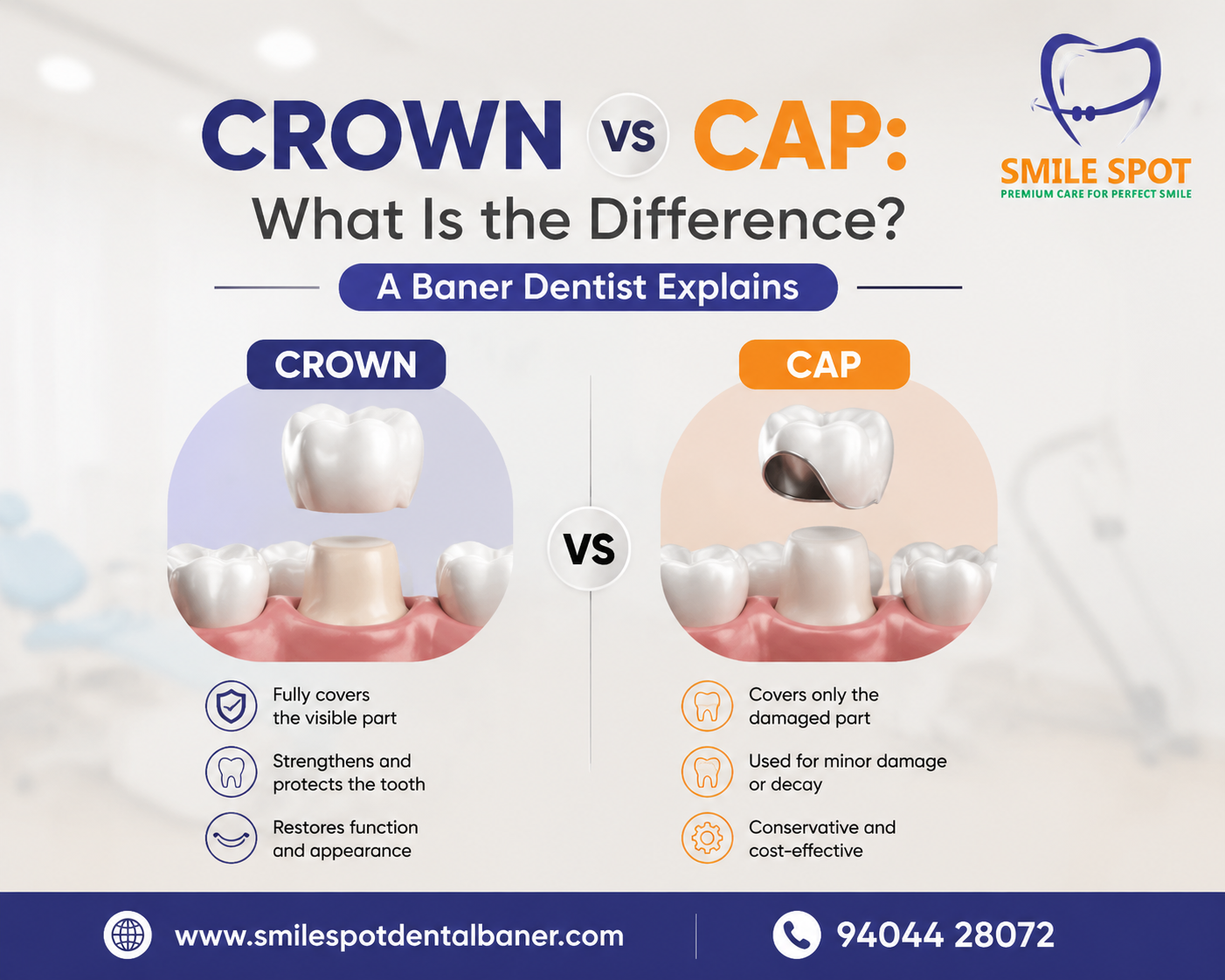
Your dentist says you need a ‘crown’. Your family refers to it as a ‘cap’. Are they the same thing? Yes, they are. Dental crown vs cap difference Baner dentist is one of the most common confused patient queries we see, and the confusion is completely understandable.
This post explains the crown vs cap question plainly, covers the four main materials available at Smile Spot Baner, explains the procedure steps and gives you transparent cost ranges. The goal is for you to walk into your appointment informed and confident about the treatment you are receiving.
Quick Facts: Dental Crowns in Baner, Pune
| Label | Fact |
| Is a crown the same as a cap? | Yes. ‘Cap’ is informal; ‘crown’ is the clinical term |
| Metal crown cost in Baner | INR 1,500 to 3,000 |
| PFM (porcelain-fused-to-metal) crown cost | INR 3,000 to 6,000 |
| All-ceramic crown cost in Baner | INR 4,000 to 8,000 |
| Zirconia crown cost in Baner | INR 8,000 to 15,000 |
| Typical crown lifespan | 7 to 15 years depending on material and hygiene |
| Number of appointments for a crown | 2 appointments (preparation and final fitting) |
Pune Dental Crown Statistics 2025-2026
| Metric | Data Point | Source |
| Molar RCT cases requiring crown protection | Over 80% | Industry estimate |
| Dental caries prevalence in Indian adults requiring restoration | Approximately 67% | ICMR, 2023 |
| Average crown lifespan with good oral hygiene | 10 to 15 years | PubMed / Prosthodontic literature |
| Share of Pune patients choosing zirconia crowns in 2025 | Approximately 40 to 50% | Industry estimate |
| Average crown failure rate over 10 years | 5 to 15% depending on material | PubMed |
| Cost of crown re-cementation after debonding in Pune | INR 500 to 1,500 | Industry estimate |
| Patients preferring tooth-coloured crowns in urban India | Over 65% | Industry estimate |
Crown vs Cap difference Baner dentist Explained
A dental crown is a tooth-shaped restoration that fits over a prepared natural tooth, covering it entirely from the gum line upward. It restores the tooth’s shape, size, strength and appearance. In everyday Indian conversation, patients call this a ‘cap’ because it sits over the tooth like a cap sits on a head.
Dentists use ‘crown’ because that is the correct clinical and prosthodontic term. When Dr. Bhole refers to your dental crown, and your family asks about your cap, they are talking about the same piece of restorative work.
When Is a Dental Crown Needed?
- After root canal treatment to protect the weakened, non-vital tooth structure, particularly for molars and premolars.
- When a tooth is severely cracked, fractured or worn down and cannot be restored with a filling alone.
- To cover a dental implant (implant crown) after the implant has integrated with the jawbone.
- For cosmetic improvement as part of a smile designing treatment when veneers are not suitable.
- To anchor a dental bridge when replacing a missing tooth without implants.
- To protect a tooth that has large, failing fillings with insufficient tooth structure remaining.
The Four Types of Dental Crowns Available at Smile Spot, Baner
1. Metal Crowns
Metal crowns are made of gold alloy, silver alloy or base metal alloys. They are the most durable option and can withstand significant biting force. They require less tooth reduction than other materials. The drawback is aesthetics: they are clearly visible when you smile, making them suitable only for back molars that do not show during normal speaking or smiling.
2. Porcelain-Fused-to-Metal (PFM) Crowns
PFM crowns have a metal substructure for strength with a porcelain outer layer for aesthetics. They look natural and are suitable for both front and back teeth. Over time, the metal margin at the gum line can become visible as gums recede slightly, which is a cosmetic concern for some patients. PFM remains one of the most commonly placed crown types in Pune due to its cost-effectiveness.
3. All-Ceramic Crowns
All-ceramic crowns contain no metal. They offer excellent aesthetics and are the best choice for front teeth where appearance is a priority. They are slightly less strong than zirconia crowns but adequate for front teeth that are not under heavy biting load. They are biocompatible and suitable for patients with metal allergies.
4. Zirconia Crowns
Zirconia (zirconium dioxide) crowns are the strongest and most aesthetic option currently available. They are metal-free, extremely durable and look virtually identical to natural teeth. Zirconia crowns are the preferred choice for patients who want the best combination of strength and aesthetics, particularly for teeth visible when smiling. They are also available as monolithic zirconia (solid, for extra strength) or layered zirconia (coated with ceramic for enhanced aesthetics).
Crown Materials Comparison Table
| Crown Type | Strength | Aesthetics | Best For | Cost in Baner (INR) | Lifespan |
| Metal | Highest | Poor (silver/gold colour) | Back molars, grinders | 1,500 to 3,000 | 15+ years |
| PFM | High | Good | Front and back teeth | 3,000 to 6,000 | 10 to 15 years |
| All-ceramic | Moderate | Excellent | Front teeth | 4,000 to 8,000 | 8 to 12 years |
| Zirconia | Very high | Excellent | Front and back teeth | 8,000 to 15,000 | 10 to 15+ years |
Procedure Steps: Getting a Crown at Smile Spot, Baner
| Step | What Happens | Chair Time |
| Appointment 1: Examination | X-ray assessment, tooth condition evaluation, material discussion | 15 to 20 minutes |
| Appointment 1: Tooth preparation | Tooth shaped under local anaesthesia to receive crown; 1 to 2 mm removed from outer surface | 30 to 40 minutes |
| Appointment 1: Impression | Digital scan or putty impression of prepared tooth sent to dental lab | 10 minutes |
| Appointment 1: Temporary crown | Temporary acrylic crown placed to protect tooth during lab fabrication | 10 minutes |
| Lab fabrication | Crown made at dental lab (typically 5 to 7 working days) | N/A |
| Appointment 2: Final fitting | Temporary crown removed, permanent crown tried in, adjusted, cemented | 30 to 40 minutes |
Post-Treatment Oral Hygiene After a Crown
A crown protects a prepared tooth but it does not make it invincible. Decay can still develop at the margin where the crown meets the gum line if oral hygiene is poor. Follow these steps:
- Brush twice daily including the gum line around the crown, where plaque accumulates.
- Floss daily. Use a floss threader or interdental brush to clean under the crown margin.
- Avoid biting very hard foods such as ice, hard candy or bones. This applies especially in the first 48 hours after crown cementation.
- Wear a night guard if your dentist has noted tooth grinding (bruxism). Grinding accelerates crown wear significantly.
- Attend annual dental checkups so the crown margin and underlying tooth can be reviewed for early signs of decay.
Cosmetic vs Clinical Indications for a Dental Crown
| Indication | Clinical Need | Cosmetic Need |
| After root canal treatment | Essential for molar protection | Secondary benefit: improved appearance |
| Cracked tooth | Prevents fracture progression and pain | Restores natural tooth shape |
| Severely worn teeth | Restores bite function and height | Restores smile aesthetics |
| Implant restoration | Required to function as a tooth | Matches adjacent tooth colour |
| Large failing filling | Prevents tooth fracture under chewing load | Removes discolouration from old amalgam |
| Cosmetic enhancement | May not be clinically necessary | Core purpose: smile redesign |
Dental Crown Care in Baner: Serving Aundh, Wakad and Pashan
Smile Spot Orthodontics and Multispeciality Dental Clinic in Baner, Pune offers all four major crown materials with in-clinic digital impressions for faster turnaround and a better fit. Dr. Akshay Bhole discusses your clinical needs, cosmetic preferences and budget during the first appointment before any preparation begins. There are no surprise costs at Smile Spot: you receive a complete treatment estimate at consultation.
Patients from Aundh, Wakad, Pashan and Sus commonly visit Smile Spot for crown placement after root canal treatment. An IT professional from Hinjewadi recently completed a zirconia crown on her upper right molar after RCT. She chose zirconia specifically because she was concerned about the metal showing during client presentations. The final crown was indistinguishable from her natural teeth.
Frequently Asked Questions
Q: Is a dental crown and a cap the same thing?
A: Yes, they are exactly the same. ‘Cap’ is the common patient term used across India, while ‘crown’ is the clinical and technical term used by dentists. Both refer to a tooth-shaped restoration that covers an entire prepared tooth from the gum line upward to restore its shape, strength and appearance.
Q: Which crown material is best for a molar tooth in Baner?
A: For molars, zirconia crowns offer the best combination of strength and aesthetics. If budget is a constraint, PFM crowns are a reliable and widely used alternative. Metal crowns are the most durable and least expensive but are only appropriate for teeth not visible when smiling. Your dentist will recommend the best material based on your bite force, aesthetic preference and budget.
Q: How long does a dental crown last in Pune?
A: Crown lifespan ranges from 7 to 15+ years depending on the material, your oral hygiene and whether you have a grinding habit. Zirconia and metal crowns tend to last longest. Regular dental checkups allow early detection of any issues at the crown margin, such as secondary decay, that can extend the crown’s functional life when caught early.
Q: Does a crown hurt? What is the procedure like?
A: Crown preparation is performed under local anaesthesia and is generally comfortable. You may feel mild pressure during tooth shaping. Soreness for 24 to 48 hours after the preparation appointment is normal. Final crown cementation is quick and painless. Most patients find the process far less uncomfortable than they expected.
Q: Do I need a crown after every root canal treatment?
A: Not always, but for most molar and premolar teeth, yes. Root canal treatment removes the tooth’s blood supply, making it more brittle over time. A crown distributes chewing forces evenly and prevents the tooth from fracturing. Front teeth (incisors and canines) after RCT may or may not need a crown, depending on how much natural tooth structure remains.
Q: What is the cost of a dental crown at Smile Spot, Baner?
A: Crown costs at Smile Spot Baner depend on material: INR 1,500 to 3,000 for metal, INR 3,000 to 6,000 for PFM, INR 4,000 to 8,000 for all-ceramic and INR 8,000 to 15,000 for zirconia. These ranges are approximate and vary based on tooth position and case complexity. A firm estimate is provided at consultation before any treatment begins.
Conclusion
The dental crown vs cap difference question has a simple answer: they are the same restoration with two different names. What matters more than terminology is choosing the right material for your clinical situation, aesthetic needs and budget. Zirconia offers the best of all worlds if cost allows. PFM remains an excellent, proven choice for most patients.
At Smile Spot Orthodontics and Multispeciality Dental Clinic in Baner, Dr. Akshay Bhole (BDS, MDS – Orthodontics and Invisalign Provider) and the team provide transparent crown consultations with clear material comparisons and cost estimates before any preparation begins.
Ready to protect your tooth with the right crown? book a consultation at our clinic in Baner, Pune.
Leave a Reply