Table of Contents
Most people notice a Effects of a missing tooth on surrounding teeth right after it happens and then, once the gap stops feeling strange, stop thinking about it. Chewing adjusts, the space becomes part of how the mouth feels, and unless it sits at the front, it can go untreated for years without causing obvious pain. The problem is that the teeth around that gap are not standing still during that time. This article looks at what actually happens to the teeth next to a long-missing tooth, how the timeline usually unfolds, and when it is worth getting checked.
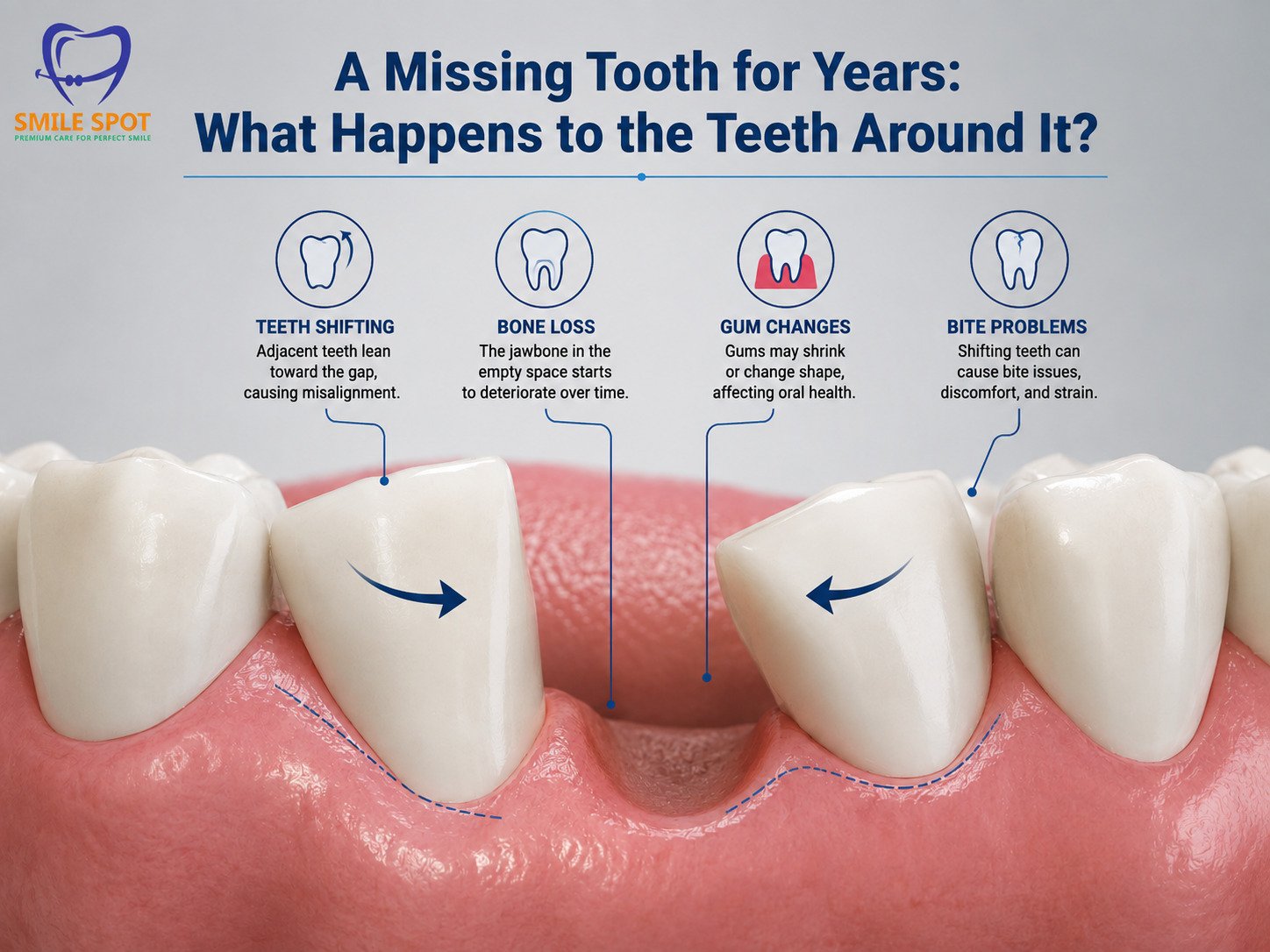
Effects of a missing tooth on surrounding teeth What Actually Happens
- The teeth on either side of the gap begin to tilt and drift toward the empty space, a movement dentists call physiologic drift.
- The tooth directly opposite the gap, in the other jaw, gradually erupts further out of the gum since it no longer meets resistance when biting. This is called supraeruption.
- As nearby teeth tilt, new gaps and tight spaces form between them, making the area harder to clean properly.
- The jawbone beneath the missing tooth loses the stimulation it used to get from chewing and begins to shrink, a process called alveolar ridge resorption.
- Your bite gradually changes shape as surrounding teeth move, which can put uneven pressure on the jaw joint.
- Your bite may also change as surrounding teeth shift, putting uneven pressure on the jaw. For expert dental care, visit Smile Spot Dental Clinic
Why This Matters More Than It Seems
- It is not only about the gap. One clinical study following patients with a long-missing molar found that 57.6% had visible drifting of the neighbouring teeth, and 23.2% had supraeruption of the opposing tooth.
- The tighter, uneven spaces created by drifting teeth trap food and plaque more easily, raising the risk of decay and gum disease in teeth that were previously healthy.
- Bone loss in the area can affect facial shape over time and can make future replacement options, such as an implant, more complicated without bone grafting.
- The altered bite can strain the jaw joint and, in some patients, contribute to jaw pain or clicking, generally described as temporomandibular discomfort.
- The longer the gap stays open, the more these changes tend to compound, so what starts as one missing tooth can, over years, affect several teeth around it.
- The longer the gap stays open, the more these changes tend to compound. Early dental treatment can help prevent further problems.
What Happens Over Time
| Timeframe | What Typically Happens |
|---|---|
| First few months | Jawbone loss begins in the area, though it is not visible yet. Chewing pattern starts adjusting. |
| Around 1 year | Industry estimates suggest the bone ridge can lose up to a quarter of its width in the first year alone. Neighbouring teeth may show early tilting. |
| 2 to 5 years | Drifting and supraeruption become more noticeable. Bite changes are more established and the area is harder to clean. |
| 5+ years | Bone loss can make future implant placement more complex, sometimes needing grafting. Adjacent teeth may show wear, decay or looseness from years of altered pressure. |
What Dental Research Shows
Physiologic drift and supraeruption are well documented in dental literature. Industry estimates place first-year bone width loss at up to 25%, and research on tooth loss has linked long-term gaps to changes in jaw joint function in some patients. None of this means every missing tooth leads to serious complications. The extent varies by which tooth is missing, a patient’s bite and how long the gap is left, but the general pattern of drifting, supraeruption and gradual bone loss is consistent across most of the available research.
Signs You Should Get It Checked Soon
- Food constantly getting stuck in the same spot near the gap
- A tooth on either side of the gap feels like it has shifted position
- Your bite feels different when you close your mouth compared to a few years ago
- Jaw clicking, soreness or tension that was not there before
- A tooth opposite the gap looks longer than the teeth beside it
How Smile Spot Approaches a Long-Pending Missing Tooth
At Smile Spot Orthodontics & Multispeciality Dental Clinic in Baner, patients often come in years after losing a tooth, usually once they notice one of the signs above rather than the original gap. The first step is an assessment of how much the surrounding teeth and bite have already shifted, since that decides whether replacement can happen directly or needs orthodontic movement first to bring the teeth back into a workable position.
What You Can Do Before Your Appointment
- Note when the tooth was lost, even an approximate year helps in assessing how much drift to expect
- Pay attention to which side you chew on and whether that has changed
- Keep the area as clean as possible in the meantime, since drifted teeth are more prone to decay
- Do not ignore any new sensitivity or looseness in the teeth next to the gap
- Bring any old dental X-rays if you have them, since they help show how much has changed over time
Frequently Asked Questions
Can a missing tooth really affect the teeth next to it?
Yes. The teeth beside a gap tend to tilt toward it over time, and the tooth opposite the gap can gradually erupt further out of the gum since it has nothing to bite against.
How long does it take for teeth to start shifting after a tooth is lost?
Some bone loss begins within months, and visible shifting of the neighbouring teeth is often noticeable within one to a few years, though the exact timeline varies by patient.
Is it too late to fix things if a tooth has been missing for years?
In most cases, no. Longstanding gaps often need more planning, sometimes involving orthodontic movement before replacement, but a dentist can usually still work with the current position of your teeth.
Does a missing back tooth matter as much as a missing front tooth?
It matters differently rather than less. Back teeth carry more chewing load, so a long-missing back tooth is more likely to cause bite changes and bone loss, even though the gap is less visible.
What is the first step if I have had a missing tooth for years?
An examination and X-ray to see how much the surrounding teeth and jawbone have shifted, which decides whether a direct replacement or additional treatment is needed first.
Conclusion
A missing tooth does not stay contained to the space it left behind. The longer it goes without attention, the more the surrounding teeth, bite and jawbone tend to adjust around it, and those adjustments are usually easier to manage the earlier they are addressed. If a tooth has been missing for a while, an assessment now is a reasonable place to start. Call Smile Spot Orthodontics & Multispeciality Dental Clinic in Baner to get it checked.
Leave a Reply