Key Takeaways of
- Straight teeth (alignment) and a correct bite (occlusion) are two different things, and treatment can achieve one without fully achieving the other if not planned and finished correctly
- Mild bite changes in the first 1 to 2 weeks after braces or aligners are normal ligament settling, not a problem
- Retainer non-compliance is one of the most common reasons a straight smile develops a bite problem months or years later
- Underlying skeletal jaw discrepancies sometimes cannot be fully corrected by tooth movement alone
- TMJ (jaw joint) dysfunction can cause bite discomfort even when the teeth themselves are well aligned
- Persistent bite pain, clicking, uneven wear or difficulty chewing more than a month after treatment should be evaluated
- Dr. Akshay Bhole at Smile Spot Baner offers bite assessments and Invisalign based correction for patients across Baner, Aundh, Wakad and Pashan
Introduction
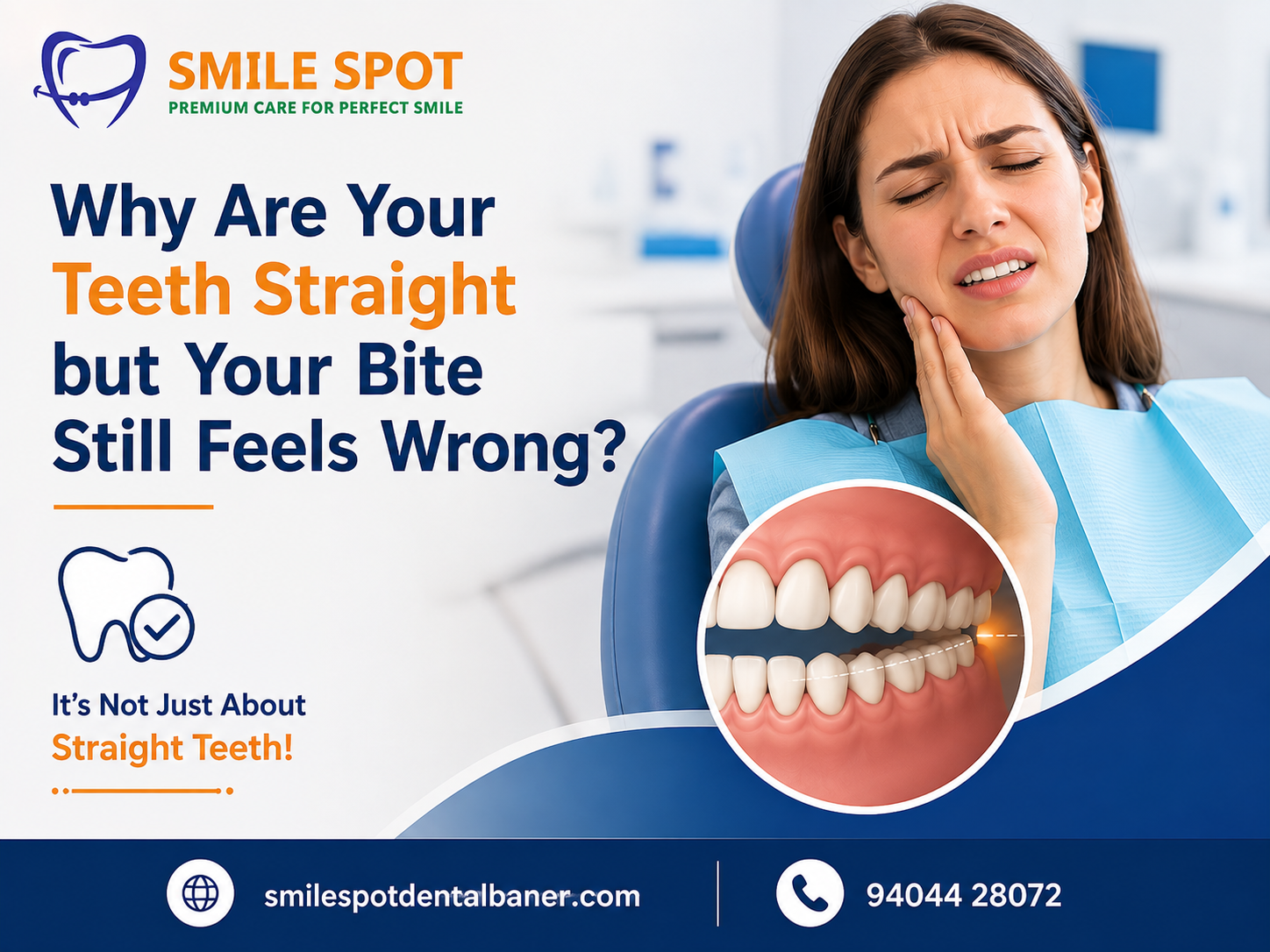
Your teeth look straight in the mirror. Your smile finally looks the way you wanted after months of braces or aligners. But when you bite down, something still feels off, one side seems to touch first, chewing feels uneven, or your jaw feels tired by the end of the day.
This is a more common experience than most patients expect, and it catches people off guard because straight teeth are usually treated as the finish line. In reality, alignment and bite are related but separate things, and a bite that feels wrong despite straight teeth almost always has an identifiable cause.
If you are experiencing changes in your bite or want to understand whether your teeth and jaw are functioning properly, a consultation at our dental clinic in Baner can help identify the underlying issue. This guide walks through what is actually going on, which causes are normal and temporary, which need a proper check, and what correction options look like for patients in Baner and nearby areas of Pune.
Quick Facts: Straight Teeth versus a Correct Bite
| Label | Fact |
| What straight teeth measure | The position of teeth in a row, how they look |
| What a correct bite measures | How upper and lower teeth meet and function together, called occlusion |
| Normal post-treatment settling | Usually resolves within 1 to 2 weeks |
| When to see an orthodontist | If bite discomfort persists beyond 4 weeks or causes pain |
| Most common preventable cause | Inconsistent retainer wear after treatment |
| Who can assess a bite problem | An orthodontist, using a clinical exam and bite records |
What the Evidence Says About Bite Changes After Treatment
| Metric | Data Point | Source |
| Teeth movement reported in the weeks after debonding (ligament settling) | Widely reported by patients, mostly resolving within days to weeks | Clinical literature (NCBI/PMC) |
| Orthodontic relapse linked to retainer wear | Inconsistent retainer wear is a leading cause of post-treatment bite and alignment shift | Clinical literature (NCBI/PMC) |
| Bite force changes after fixed appliance removal | Bite force and occlusal contact patterns can continue changing for months after debonding | Clinical literature (NCBI/PMC) |
| Patients seeking a check for bite discomfort after prior treatment | A meaningful share of cases resolve with a retainer adjustment alone | Industry estimate |
| Adults reporting at least mild TMJ symptoms at some point | A notable proportion of the adult population | Industry estimate |
| Bite issues tracing to a skeletal rather than purely dental cause | A minority of cases, but clinically significant when present | Industry estimate |
Why Straight Teeth Do Not Always Mean a Correct Bite
Braces and clear aligners are very effective at moving teeth into a straighter position, which is what most patients notice first and care about most. But teeth alignment is only one part of what orthodontists call occlusion, the way your upper and lower teeth meet and function together when you bite, chew and speak.
A bite can look straight from the front and still be off in ways that are not visible in a mirror, such as one side making contact before the other, a slight rotation in a back tooth, or the lower jaw sitting slightly forward or back relative to the upper jaw. These small discrepancies do not always affect appearance, but they can affect how the bite feels and functions. To learn more about our approach to comprehensive dental and orthodontic care, visit our Clinic.
Common Causes of a Bite That Feels Wrong After Straight Teeth
Normal Post-Treatment Settling
In the first 1 to 2 weeks after braces are removed or aligner treatment finishes, it is common and expected for the bite to feel slightly different. The ligaments holding each tooth need a short period to firm up in their new position, and the bite may feel unfamiliar simply because the jaw muscles are adjusting. This is not a problem, and it usually settles on its own within a couple of weeks.
Retainer Non-Compliance and Relapse
Teeth are not fixed in place once braces come off. Without consistent retainer wear as prescribed, teeth gradually drift back toward their original position, a process called relapse. This does not always show up as visibly crooked teeth right away, small shifts can change how the bite meets before they become visually obvious, which is often why a bite starts to feel wrong months or years after treatment ended.
Underlying Skeletal Discrepancy
Braces and aligners move teeth within the jawbone, but they cannot fully correct a significant mismatch in the size or position of the upper and lower jaws themselves. In some cases, teeth are aligned as well as possible within the limits of the existing jaw structure, which can leave a residual bite discrepancy that tooth movement alone could not resolve. This is usually identified early in treatment planning, but it is worth understanding as a possible cause if a bite issue was present before treatment as well.
TMJ (Jaw Joint) Dysfunction
The temporomandibular joint, the hinge connecting the jaw to the skull, can develop its own dysfunction independent of tooth position. Clicking, popping, jaw fatigue or discomfort near the ears can occur even with well aligned teeth, and can also make a perfectly good bite feel wrong because the joint itself is not functioning smoothly.
Grinding, Clenching and Tongue Habits
Teeth grinding, jaw clenching and tongue thrusting habits can all gradually alter how the bite feels, sometimes wearing down tooth surfaces unevenly or placing ongoing strain on specific teeth and joints. These habits often develop or worsen with stress and may not be noticed by the patient, especially if they happen during sleep.
Wisdom Teeth Eruption
Wisdom teeth that erupt after orthodontic treatment is complete can place gradual pressure on the back teeth, contributing to a shift in the bite over time. This is one reason orthodontists often evaluate wisdom tooth position before finishing treatment.
Incomplete Occlusal Adjustment
In some cases, teeth are moved into a well aligned position but a final bite adjustment, called occlusal equilibration, was not carried out or was not fully completed. This is a targeted adjustment of high contact points identified through bite analysis, and its absence can leave certain teeth meeting slightly early or hard, which the patient experiences as the bite feeling wrong.
Signs Your Bite Needs a Professional Check
- Bite discomfort or unevenness that has not improved after 4 weeks
- One side of the jaw doing noticeably more chewing work than the other
- Clicking, popping or a locking sensation in the jaw joint
- Waking up with jaw soreness or headaches, which can point to nighttime grinding
- Visible uneven wear on the biting edges of teeth
- A retainer that no longer fits the way it used to
- Difficulty biting into or chewing certain foods that was not a problem before
How an Orthodontist Diagnoses a Bite Problem
A bite assessment usually starts with a clinical examination of how the teeth meet, followed by bite registration records that capture the exact contact pattern between the upper and lower teeth. Depending on findings, this may be supported by digital scans, photographs or an X-ray to check the jaw joint and root positions. For patients who had previous orthodontic treatment, our orthodontist also reviews whether the original treatment plan and retention protocol were followed as intended. You can also explore our dental services to see the range of treatments available at our clinic.
Treatment Options for Correcting a Bite After Straight Teeth
| Option | What It Involves | Best For |
| Retainer adjustment or replacement | Refitting or remaking a retainer to guide minor relapse back into position | Mild relapse caught early |
| Minor aligner re-treatment | A short course of clear aligners to fine tune tooth position and contact | Mild to moderate shifts after previous treatment |
| Occlusal equilibration | Selective, minor adjustment of high contact points on specific teeth | Bite discomfort from uneven contact points |
| Night guard or splint therapy | A custom appliance worn at night to reduce grinding and clenching strain | Bite issues linked to bruxism or TMJ strain |
| TMJ focused therapy | Jaw exercises, splint therapy or referral for joint specific treatment | Bite discomfort centred on the jaw joint itself |
| Comprehensive re-evaluation | A full reassessment of alignment, bite and jaw relationship | Persistent or complex bite concerns |
Normal Settling versus a Real Problem: A Simple Timeline
| Timeframe | What Is Normal | When to Get It Checked |
| Week 1 to 2 after treatment | Mild looseness, unfamiliar bite feel while ligaments settle | Severe pain or inability to bite down at all |
| Week 2 to 4 | Bite feel should be steadily improving | No improvement or the bite feels like it is getting worse |
| Month 1 to 3 | Bite should feel stable and comfortable | New discomfort, clicking or visible tooth shift appears |
| Beyond 3 months | Bite should be fully settled | Any bite change at this stage warrants an evaluation |
Bite Correction in Baner: Serving Aundh, Wakad, Pashan and Hinjewadi
Dr. Akshay Bhole at Smile Spot Orthodontics and Multispeciality Dental Clinic in Baner regularly sees patients, including some who completed orthodontic treatment elsewhere, whose bite does not feel right despite having straight teeth. A proper bite assessment, including a review of retainer wear history and a clinical bite check, usually identifies the cause within a single visit.
For example, a patient in his late twenties from Wakad had completed aligner treatment a year earlier and noticed his bite gradually feeling less even over several months. A bite assessment at Smile Spot found early relapse linked to inconsistent retainer wear. A short course of refinement aligners combined with a properly fitted new retainer resolved the issue, and his bite has remained stable since.
Frequently Asked Questions
Q: Is it normal for my bite to feel different right after braces or aligners come off?
A: Yes. A slightly unfamiliar or loose feeling bite in the first 1 to 2 weeks after treatment is common while the ligaments around your teeth settle into their new position. This typically resolves on its own without treatment.
Q: How long should I wear my retainer to prevent my bite from shifting?
A: Retainer wear schedules vary by patient, but most orthodontists recommend full time wear for an initial period followed by nightly wear long term, often indefinitely, since teeth can continue to shift with age even years after treatment. Your orthodontist will confirm the specific schedule for your case.
Q: Can a bite problem be fixed without redoing full orthodontic treatment?
A: Often yes. Many bite issues that develop after straight teeth are addressed with a retainer adjustment, a short course of refinement aligners or a targeted occlusal adjustment, rather than a full repeat of treatment. The right option depends on what the assessment finds.
Q: Could my bite problem actually be a jaw joint (TMJ) issue rather than a tooth alignment issue?
A: It is possible. TMJ dysfunction can cause bite discomfort, clicking or jaw fatigue even when the teeth themselves are well aligned. A bite assessment usually distinguishes between a tooth contact issue and a jaw joint issue, since the treatment approach differs.
Q: I grind my teeth at night, can that be why my bite feels wrong?
A: Yes, grinding and clenching can gradually alter how teeth meet and place ongoing strain on the jaw joint, both of which can make a bite feel wrong over time. A night guard is often recommended alongside addressing the underlying bite contact.
Q: Should I be worried if my retainer suddenly feels tight?
A: A retainer that feels tight after fitting properly for a while usually indicates some degree of tooth movement has already occurred. It is worth having this checked rather than continuing to force the retainer, since forcing a retainer that no longer fits can cause discomfort without correcting the underlying shift.
Q: How do I book a bite assessment at Smile Spot in Baner?
A: Visit smilespotdentalbaner.com or contact the clinic directly on Baner Road, Pune, to schedule a bite assessment with Dr. Akshay Bhole. Most assessments can identify the cause of a bite problem within a single visit.
Conclusion
Straight teeth and a correct bite are related but different outcomes, and a bite that feels wrong despite a straight looking smile almost always traces back to an identifiable cause, whether that is normal short term settling, retainer relapse, a jaw joint issue or an incomplete bite adjustment. Most of these causes are straightforward to diagnose and do not require starting orthodontic treatment over from the beginning.
Dr. Akshay Bhole (BDS, MDS – Orthodontics and Invisalign Provider) and the team at Smile Spot Orthodontics and Multispeciality Dental Clinic in Baner offer bite assessments for patients who have completed treatment either at Smile Spot or elsewhere and want to understand why their bite does not feel right.
For a bite assessment or orthodontic consultation contact our clinic on Baner Road, Pune.
Leave a Reply